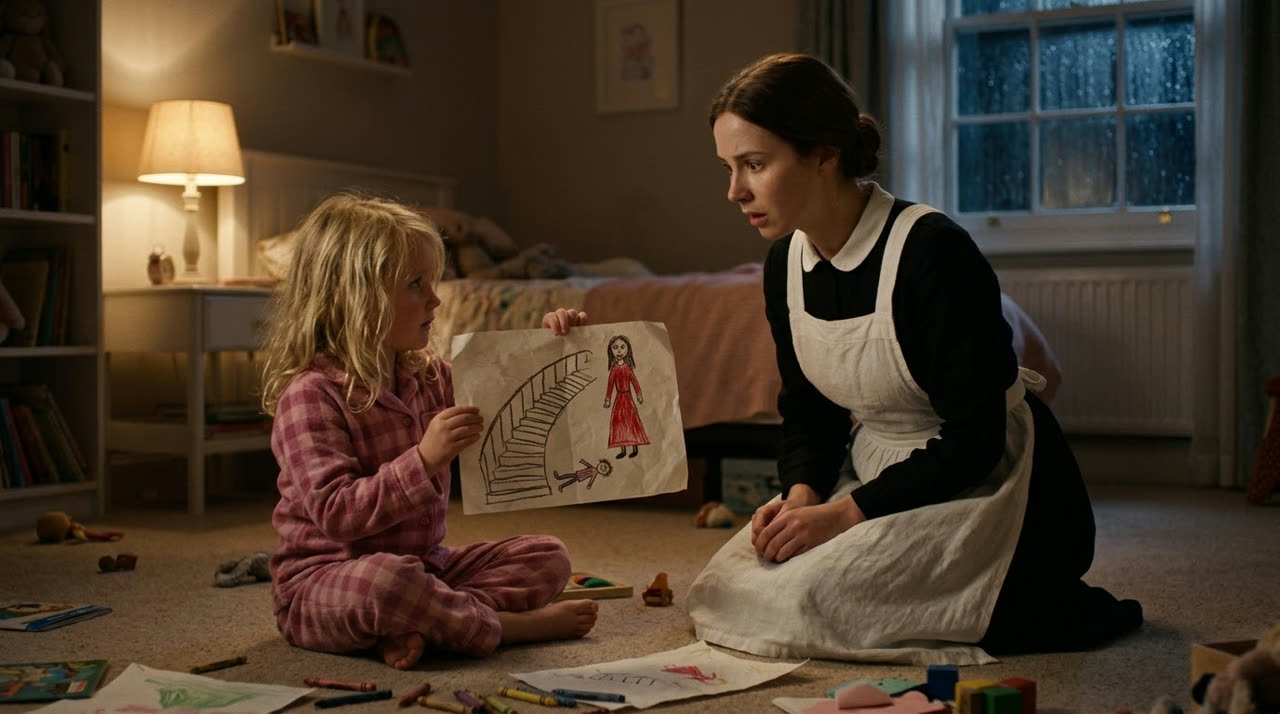
Emma didn't sleep that night.
She sat on the edge of her narrow bed with the empty glass vial in one hand and Rosie's brown bottle in the other. She had taken it from the nightstand at three in the morning, while the whole house was asleep, and she had to return it before eight.
She held them side by side under the lamp.
Same brown glass. Same dropper cap. Same handwriting on the faded labels.
She opened Rosie's bottle and smelled it. Bitter. Faintly sweet underneath, the way some strong medicines are made sweet so children will swallow them without complaining.
Emma had worked night shifts in a children's ward for six years. She didn't need a laboratory to make a guess.
This wasn't a gentle calming remedy. This was something that put people to sleep. Heavy, deep, foggy sleep.
And someone had been giving it to a six-year-old girl every single night for a year.
Emma sat very still. Then she went to the small sink in the corner of her room and did something she had never done in her whole career.
She poured half the bottle down the drain.
Then she filled it back up with water, a little at a time, until it reached exactly the same line.
Her hands were shaking when she finished.
At seven-forty, she slipped into Rosie's room, set the bottle back on the nightstand in exactly the same position, and walked out again.
Nobody saw her.
At least, she hoped nobody did.
Over the next five days, something began to change.
Rosie woke up earlier. Her eyes, which had always looked a little cloudy in the mornings, were clear and bright. She ate breakfast without being asked. She followed Emma around the house like a small blonde shadow, pointing at things she wanted Emma to look at: a bird on the windowsill, a spider in the greenhouse, a rainbow made by the crystal lamp in the library.
She still didn't talk. Not real words.
But she hummed all the time now. The lullaby. Over and over, as if she were afraid she might forget it.
On the fifth evening, Daniel stopped Emma in the hallway.
"She laughed at dinner," he said, sounding almost confused. "At something on the television. A cartoon dog. She laughed out loud."
"I know. I heard."
"Dr. Pierce says it's the medicine finally working."
Emma kept her face very still. "Does he?"
Daniel studied her. He was a man who had built a company by reading people across conference tables. Emma could feel him trying to read her now.
"You don't like Dr. Pierce."
"I don't know Dr. Pierce, sir."
"That isn't an answer."
"No," Emma said quietly. "It isn't."
The idea came to her on Saturday, during a rainstorm.
Rosie was bored. She had colored every page in her coloring books. She had built a tower of blocks taller than her bunny and knocked it down four times.
Emma took a fresh pad of white paper from the desk and laid it on the carpet with a box of crayons.
"Rosie, will you draw something for me?"
Rosie picked up a yellow crayon and drew a sun.
"That's beautiful. Can you draw your house?"
Rosie drew a big square with lots of windows. A tree. A fountain.
"Can you draw your mommy?"
Rosie's hand stopped.
She looked at Emma for a long moment. Then she put down the yellow crayon and picked up a brown one, and very carefully drew a woman with curly hair. She added a yellow scarf. A big smile.
"She's lovely," Emma whispered. "Rosie… can you draw the night your mommy got hurt?"
The room went silent except for the rain.
Emma thought she had gone too far. She was about to take the paper away and say never mind, sweetheart, when Rosie pulled a fresh sheet toward herself.
She picked up a black crayon.
She drew a staircase. A big one, curving, with lots of steps. The grand staircase in the front hall.
At the bottom, she drew the curly-haired woman with the yellow scarf. Lying down. Her eyes were drawn as two little crosses.
Emma's chest tightened.
Then Rosie picked up another crayon. A red one.
At the top of the staircase, she drew another woman. Tall. Long straight black hair. A long red dress that went all the way down to her feet.
The woman's arms were stretched out in front of her.
As if she had just pushed something away.
Rosie put the crayon down. She looked at the drawing, then at Emma. Her lower lip trembled.
Then, very quietly, she pressed one small finger on the woman in red.
And shook her head. No. No. No.
Emma pulled Rosie into her arms and held her tight while the rain hammered on the windows.
"I believe you," she whispered into her hair. "I believe you, sweetheart. You're safe. I've got you."
That night, after Rosie fell asleep, Emma went down to the kitchen. Mrs. Hart was sitting alone at the long table with a cup of tea that had gone cold.
Emma sat across from her.
"Mrs. Hart. The night Mrs. Whitmore died. Who was in the house?"
The old woman's cup rattled against its saucer. "Why are you asking me that?"
"Please."
Mrs. Hart glanced at the door. Then she leaned forward and spoke very low.
"Mr. Whitmore was in London. Flight delayed. The staff had the night off, all except me. And Miss Crane came by around nine. To drop off a gift, she said. She'd been at a charity dinner in the city." Mrs. Hart swallowed. "She was still in her evening gown."
"What color was the gown?"
Mrs. Hart looked at her with frightened eyes.
"Red," she whispered. "It was red."
Emma ran upstairs.
She had left the drawings on Rosie's desk, under the box of crayons, with the house picture on top so no one would see.
She opened the door quietly. Rosie was sleeping, her bunny under her chin.
Emma crossed to the desk and lifted the crayon box.
The house drawing was there. The sun was there. The picture of Caroline with her yellow scarf was there.
The staircase drawing was gone.
On the desk, where it had been, lay a single long red thread, as if it had caught on something and been pulled loose.
And on the nightstand, the brown bottle had been moved.
It was full again. All the way to the top.
Someone had refilled it tonight.